|
Joy Harjo, the musician, activist, and former National Poet Laureate, will release her new album, Insomnia and Seven Steps to Grace, on April 24th via Smithsonian Folkways. Produced by Grammy-winning composer, bassist, and vocalist esperanza spalding, it is Harjo’s debut release for the label.
On the album, Harjo treads the fertile ground at the intersection of jazz and poetry, leaning into the improvisational aspects of both while incorporating other sonic touchstones from throughout her life: prog rock, grunge, and, crucially, the traditional music of Native communities throughout the Southwest. “This musical project has found its footing during a time of thick-layered turmoil throughout our communities,’” Harjo writes in the album’s extensive liner notes which give shape to Harjo’s history as an artist, poet, and musician. At once playful, confrontational, and devotional, Insomnia and Seven Steps to Grace arrives shaped by collective upheaval, ancestral memory, and the enduring power of art to bear witness and create change. Like in her acclaimed books of poetry, Harjo explores her matriarchal lineage, the struggle for justice for marginalized peoples, and her own cultural heritage as a member of the Muscogee Nation. Reflecting on what we can show future generations when they look back to see how we responded when confronted with injustice, Harjo remarks: “They will look to our arts.” In this way, “this album is an offering.”
Harjo and spalding’s artistic collaboration came out of their initial meeting in 2017, when they were both awarded Art of Change Ford Foundation Fellowships in Chicago. “I had long admired the artistry of spalding, her precise magic in bass, voice, and connection, and hesitated to speak to her because I was in such awe,” Harjo wrote. “[T]hen there we were, as if we already knew each other.” Recorded at The Church Studio in Harjo’s hometown of Tulsa, Oklahoma, Insomnia and Seven Steps to Grace was a chance for Harjo and spalding to work together, alongside guitarist Matthew Stevens and drummer Justin Tyson.
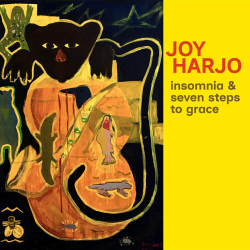
The title track opens the album in a suspended, otherworldly space—Harjo’s recitation floating over luminous harmonies and indie-rock guitar textures, guided by the imagery of the panther and the space between waking and dream. “In our family, we are related to the panther,” Harjo writes. “We need fresh dreaming to navigate what we are going to encounter.” Listen to “Insomnia and Seven Steps to Grace” HERE.
The record moves fluidly between moods: the noir-tinged, funk-driven “Rabbit Is Up to Tricks;” the marching, chaotic swell of “I Pray for My Enemies,” where Native flute echoes military fife (in Harjo’s rendition of “When Johnny Comes Marching Home Again”) and prayer becomes confrontation; and “Fear Redux,” which builds from a gnarly, driving bassline into gongs, tenderness, and reclamation as fear is named, faced, transformed. Elsewhere, Harjo performs music by Charles Mingus and the indigenous a capella group Ulali, pays tribute to James Brown, and plays alongside vocals from singer-songwriter Ganavya.
The album also pays homage to Harjo’s family and musical life, which started long before she emerged as a poet. As a child, she used to listen to her mother compose music at the family kitchen table and sing at parties around Tulsa. Despite her mother’s rich musical life, the norms and demands of the era made her mother unable to pursue the arts full-time. While assembling the album, Harjo’s sister uncovered a song called “My Guy,” which her mother wrote in the 1950s or ’60s but never released. Harjo, spalding, and Stevens reanimate “My Guy” on this album as a jazz-inflected love song featuring spalding’s vocals and punctuated by Harjo’s alto sax. “My mother would be so honored and thrilled to hear how esperanza makes vocal art of her songwriting art,” Harjo writes. “What a pairing!”
Throughout Insomnia and Seven Steps to Grace, sound itself becomes a guide, insisting that art is not an escape from hard times, but a way through them. “Because of what keeps us up at night,” Harjo writes, “the bad dreams, the good ones, the tenderness, the beauty, the heartache, the struggle: this album.”
Pre-order Insomnia and Seven Steps to Grace - which also features Harjo’s first original painting in years in its packaging and cover art - HERE.
|