
Black BoxClient Information
8 December, 2025Print
Black Box: Top Artist Brands Of The Decade
Since we launched Black Box ten years ago, the music market has shifted over and over again. Streaming killed the download, touring became our primary revenue engine…then disappeared overnight in 2020, TikTok replaced artist development, fans became A&Rs, and AI crept into our daily conversations. Disruption continued to reign.

The artists on our decade’s best list strategically navigated their music release plans, fan relationships, and personal narratives to build lasting and recognizable brands in an unpredictable era. In addition to the one constant – great music – our takeaways on what they all have in common are clear.
- Community is everything. – An artist is only as viable as their connection to a core, urgent fanbase. Respect them, listen to them, and be one of them.
- “Hits” are only a statistic. – Hit songs come and go overnight, sometimes blowing up years or decades after their initial release. They’re always necessary, but a massively successful song can be a death sentence for an artist without a strong identity – a strong brand will keep an artist relevant to their super fans with or without crossover hits.
- Transparency = control. – Owning the narrative has been the best risk management tool of the last decade.
So, here it is. Black Box’s Best Brands Of The Decade.
11. Kacey Musgraves
As country music took over pop, it mostly split into two: those reclaiming rootsy tradition, and those chasing radio. Kacey Musgraves focused instead on welcoming in new listeners to the genre who crave something more alternative.
Her branding has never waned throughout the decade and has proven remarkably durable album-to-album. The cosmic cowgirl, an earthy stoner in sequins. A small-town over-thinker, writing blunt songs explicitly for outsiders of modern country: people who did not connect with the genre’s post-war ideas of gender or national pride, and queer youth.
Kacey’s superpower is as a community organizer. Hosting release parties at drag bars, including drag queens in her live shows, and co-creating AppleTV’s My Kind of Country to spotlight LGBTQ+/POC artists. She’s built a defiantly progressive space within Nashville’s conservative establishment. Golden Hour‘s Album of the Year GRAMMY win proved that the establishment could be forced to change, helping reset what “country” could be.
10. The 1975
The 1975 have capitalized on being digital natives, capturing the mania of being alive and online.
Their sprawling albums blend and remix influences into post-genre chaos; full of navel-gazing philosophy and undeniable pop songwriting. To balance that sprawl, they’ve built sleek visuals and clean, iconic stage designs that feel consistent across each album-era rebrand. They’ve cultivated a devoted live audience, become a consistent arena force, and headlined Glastonbury.
The 1975’s key brand relevance is their fluency in fan language: lurking subreddits, responding directly on Twitter/X, pioneering “best practices” on socials and then quickly abandoning them when everyone follows suit. They’re willing to be cringe, problematic, and earnest in public. That messiness makes them great interviewees, interesting avatars for fans, and it’s made them ubiquitous as a favorite among younger creatives.
In a sanitized era, they say the uncomfortable part out loud. Always reinventing, consistently relevant, but never over-exposed.
9. Harry Styles
Harry Styles reigned as the era’s chameleonic arena rockstar. His intentionally vague lyrics and classic influences allow listeners to project their own ideas onto him, spawning universal hits like “Sign of the Times” and “As It Was” (the 5th-most successful song ever). His devoted global fanbase is united by one broad message: “Treat People With Kindness.”
Harry’s brand consistently reflects this ethos. His androgynous style sparked debate about masculinity and gender fluidity, and he actively supports LGBTQ+ youth and mental health orgs. This vibe made Love On Tour (2021–2023) a post-pandemic pilgrimage, where strangers complimented each other freely. His influence on modern fandom is a core focus of New York Times bestseller Everything I Need I Get From You: How Fangirls Created the Internet as We Know It.
Harry rarely goes direct-to-consumer through socials, but he is the center of gravity of a rich real-world community. His value-based brand always tracks with the gentle working-class kid fans first met in One Direction: an open-hearted guy who loves classic music and making people feel less alone.
8. Bad Bunny
Bad Bunny has now spent three straight years as Spotify’s most-streamed artist worldwide, and Un Verano Sin Ti is the most-streamed album in platform history (20 billion). His messaging never wobbles: he’s a hometown hero, here to celebrate heritage, to drag machismo, to upend old gender norms, and to give his people an avatar.
His flamboyant and unorthodox style has distinctly set him apart from the Latin establishment. As reggaetón became a reliable pop sound, Bunny used it as a Trojan Horse to bring salsa, plena, and other traditional Caribbean sounds to a mainstream audience, deliberately linking younger audiences to music that their parents and grandparents enjoyed. His fans wear his nail art, copy his fits, travel for his residency in Puerto Rico, and treat his choices (who he calls out, what he experiments with) as community victories or calls to action.
His 2022 tours — El Último Tour del Mundo and World’s Hottest Tour — set the all-time record for touring revenue in a single year ($435M), sung entirely in Spanish even as he took over U.S. stadiums. His ongoing Debí Tirar Más Fotos stadium tour excludes the mainland U.S., in response to ICE raids and immigration enforcement targeting his fan base. His offer to the fans: come see him in Puerto Rico to feed the island’s economy. Bunny’s relevance is built on focusing on safety and dignity for his community first, and traditional markets second.
7. Kendrick Lamar
Kendrick Lamar has been critically, commercially, and culturally relevant at every second of his career. Academic, ambitious in scope, and always directly in touch with what everyday black Americans were talking about.
What’s striking is how little Kendrick has relied on fan engagement. His brand is his mystique, using his persona as a deep thinker (including a 2018 Pulitzer Prize) to ration his energy. No constant livestreams, no UGC campaigns. Instead: thoughtful albums, focused features, and blockbuster tours. When he chooses to participate in the pop conversation (such as his Super Bowl Halftime Show, or his earth-scorching beef with Drake in the summer of 2024), it feels important to the culture.
His two most recent albums (Mr. Morale & the Big Steppers and GNX) show the duality of his marketing. Mr. Morale, an introspective and dense low-promo release; GNX, a sharp, hook-forward album built for high impact. Both proved to be massive cultural touchstones, whether by virtue of their substance or their radio saturation. Kendrick’s craft controls the conversation.
His craftsmanship and philosophy glue his community together. The few external pressures he has faced have always been hand-waved away by returning to his core values: telling the truth, championing his hometown, and athletically challenging himself to be the Best of the Best.
6. BTS
Few artists have codified fandom like BTS. The group emerged as an upstart underdog, taking over the world slowly and methodically, until they were suddenly a force of nature by 2020.
Over the last decade, BTS and their ARMY co-chaired a transnational franchise. The group formed their early relationship with fans by talking frankly about burnout, exams, mental health, and generational pressures. In return, ARMY gave BTS stratospheric streaming and sales figures, allowing the group to cross over into English-speaking markets. More than any other act, they helped break the language barrier and allow K-pop to become a powerful market force in the West.
Their brand durability is in their discipline and structure. BTS’ commercialization of their fandom, and their consistent feedback loop with their fans, standardized how artists could connect to their audience in the 2020’s. Long-form YouTube series, variety content, individual livestreams, web toons, behind-the-scenes vlogs, spectacle event tours. They’ve meticulously layered the branding of the group and each individual member’s separate solo careers. When the band isn’t together, the idea of BTS is still always on-cycle. Their relevancy withstood the COVID touring shutdown (pioneering paid livestream events), and even the band members’ state-mandated military tenures. We look forward to seeing how they might evolve again, as they return from hiatus.
5. Charli XCX
Charli started 2015 as a major-label act failing to launch. She focused inward. She was an early hyperpop architect, concentrated her cool factor into pandemic quarantine hype (how i’m feeling now), and niche cult stardom (CRASH) that set up BRAT for its global domination in 2024.
Much like The 1975, Charli has always embraced being terminally online as a superpower. This gave her a populist edge and a direct line to the culture. Her fans have A&R’d her projects, she feeds them with off-the-cuff brain-rot content, and she celebrates queer nightlife in her work. As she concentrated her obnoxious club-girl persona, she never felt elevated from her fans — she is and always has been one of them.
A decade of grassroots niche hype coalesced during the BRAT phenomenon. The project’s stated manifesto was to “cultivate desire, chaos, and destruction”, the crucial “obnoxious and bold” coupling of high and low art. The album swept awards and even entered political discourse (“Kamala is brat”), while always feeling like an inside joke between Charli and her fans.
4. Tyler, The Creator
Tyler, the Creator evolved album-by-album, from Odd Future’s shock-jock provocateur into a curator of vibes. Cherry Bomb, Flower Boy, IGOR, Call Me If You Get Lost, CHROMAKOPIA, and DON’T TAP THE GLASS each introduced studied, lived-in worlds. He’s excelled as a creative director — crafting distinct visuals, character motivation, and typography. He’s never chased playlist security, trusting that his fans want something challenging.
Tyler’s unorthodox album rollout strategies are singular. From announcement to post-release marketing, he releases dozens of visuals, billboards, and fan initiatives that fly by a blur of 3-4 weeks. Short, sweet, and potent periods where he creates each album’s distinct world.
His music and business grew in tandem. Golf Wang and GOLF le FLEUR* became full fashion brands; Camp Flog Gnaw became a youth culture mainstay. But his center of gravity has always been his ineffable X-factor; his perspective, his fearlessness, his sense of humor, his irreverence. His off-kilter brand has always stayed distinctly “Tyler.”
3. Lady Gaga
Lady Gaga’s path this decade was not predictable. Because of her compulsion to follow her muse, her popularity has often felt precarious, despite her status as a reigning hitmaker. But, in retrospect, her legacy as an icon and innovator is now more obvious than ever.
2017’s Joanne popularized country outings from pop stars; she made Las Vegas residencies viable for younger stars; and when COVID decimated touring, she built Haus Labs into a global cosmetics empire. Just this year, she garnered the largest audience ever for a female artist (2.1M attendees), and the inescapable “Die With A Smile” became the 3rd most successful song of all time across all metrics.
Through each mercurial career twist, Gaga’s core brand pillar has been her intense devotion to her fans. In any given interview, she will always divert to talking about her unyielding respect for her “Little Monsters.” Her legendary stage shows are avant-garde celebrations of their impact on her life. By centering her fans and trusting their intelligence in her art-forward work, she has created a feedback loop of love that will far outlive her career. There is no putting the genie back in the bottle.
2. Taylor Swift
If you were to design an artist brand in a lab for this era, you’d probably end up somewhere near Taylor Swift. Through her waxing and waning public approval, Taylor’s brand has always relied on the same verticals: diaristic songwriting, fantastical thinking, and control of her narrative.
Across the last ten years, she’s jumped from pop to folk to alternative indiscriminately across a blistering run of 11 albums (7 of new material, and 4 re-recording previously-released projects). She’s navigated scandal and success by weaving each new plot beat into her sprawling meta-narrative, ever deepening the religious loyalty of her Swifties. The “Taylor’s Versions” re-record campaign reframed a common contractual dispute as a moral cause that fans could publicly influence, rewarded with vault tracks and easter eggs.Notably, her values and the personal narrative of each new project may sometimes feel incongruous. But, by speaking directly to her die-hards and creating a secret language with them that the public often doesn’t speak, Taylor has left an undeniable fingerprint on music marketing. The apotheosis of her brand/fan feedback loop is, of course, The Eras Tour; the highest-grossing tour in history ($2B+), selling 10M+ tickets and spawning its own blockbuster film.
1. Billie Eilish
The industry of 2015 is uniquely different from 2020, let alone from 2025. But Billie Eilish’s persona has always cut through the noise of each major upheaval of the market.
Billie’s earliest uploads already showcased an unmistakable perspective: juxtaposing aggro imagery and horror-movie sound design against pure and classic songs. Her brand thesis was simple and consistent: The horror and delicacy of youth. Her commitment to some of her early aesthetics has waned, but never her commitment to that same core thesis of harshness and delicacy.
Billie was a proof-of-concept success story for SoundCloud’s mainstream reach, she’s maintained robust demand on the road, she scored a slew of massive radio hits, and she’s become a critical darling throughout the decade.
Her red carpet album cycles have never gotten in the way of her grassroots fan interaction. Her candid IG photo dumps, eco-minded merch, and touring choices, and her outspoken politics are all deeply honest reinforcements to her core brand. Her work centers authenticity, body autonomy, mental health honesty, and a deep respect for her fans’ intelligence.
More than any of her contemporaries, she is a singularly recognizable icon whose silhouette, songs, and personality have all broken through the noise to command the culture.
And some 2025 Faves + Honorable Mentions:
2hollis, 5 Seconds of Summer, Addison Rae, Audrey Hobert, Dijon, Geese, Hayley Williams, KATSEYE, Lily Allen, Lola Young, Morgan Wallen, Rosalía, Sabrina Carpenter, Sleep Token, sombr, Turnstile, and underscores.
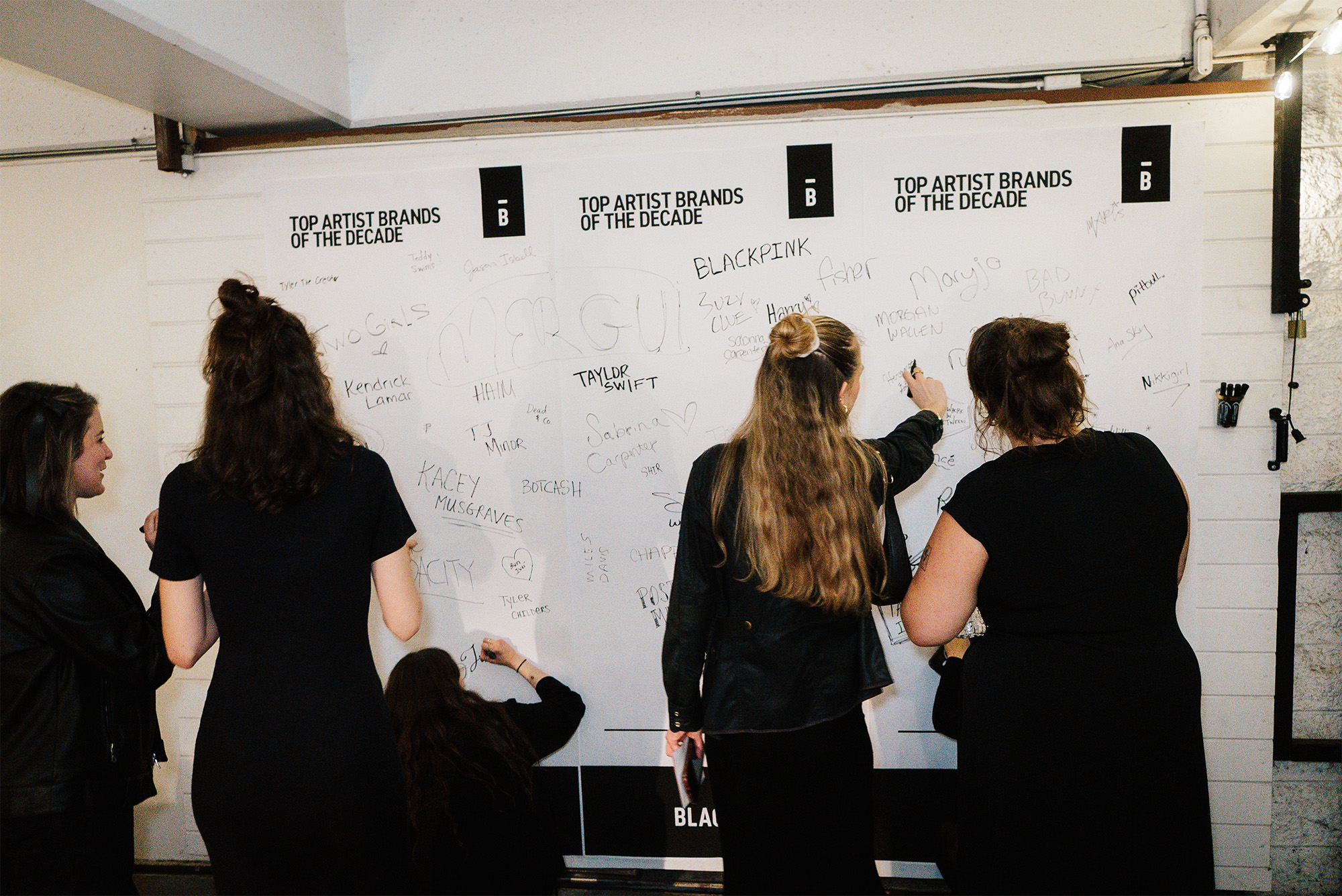
Think we missed the mark? Let us know. Also, feel free to take a trip down memory lane and check out our top artist brands from previous years!
Top Artist Brands of 2024
Top Artist Brands of 2023
Top Artist Brands of 2022
Top Artist Brands of 2021
Top Artist Brands of 2020
Top Artist Brands of 2019
Top Artist Brands of 2018
Top Artist Brands of 2017
Top Artist Brands of 2016
Top Artist Brands of 2015